EXCELLENCE IS TEAMWORK| CHINESE WHISPERS CAN RUIN GREAT PARTNERSHIPS|

INDIAN EXPRESS INSPIRES EXCELLENCE

Great Partnerships and Team work result in long lasting excellence. Championship in any domain is result of people staying together when the going gets tough and the ecosystem conspires.

A heart warming true story behind Leander Paes and Mahesh Bhupathi’s partnership breakup. Leander Paes and Mahesh Bhupathi, two of India’s most famous tennis players, have set out to tell their narrative of grit and drive that gave them world titles in tennis platforms. Break Point follows their meteoric rise to fame and the eventual decline from their celebrated victories and laurels.  The duo happened to have won eight Grand Slam doubles titles, dominating world tennis for quite some time and inspiring upcoming young budding tennis stars. The Indian legends, tennis maestros have valuable lessons of how to practice excellence and also things to avoid to keep the stellar partnership strong.

However the underlying tension, the dynamics of myriad of relationships, the coaches-managers-press and its impact on their craft; the outcomes is something that we can all take lessons from.

ENERGISING PARTNERSHIP

The bromance to breakup story truly reveals how a successful partnerships can go haywire. Every achievement whether in sports ground, corporate boardrooms, family milestones is a background story of FOCUS OF A TEAM or PARTNERSHIP. This team configuration needs to have grounded values and trust between each other. Very often with success or failures a lot of noise and Chinese Whispers creep into the otherwise beautiful chemistry. The lack of communication can further damage and distance the team members.

6 Lessons to be learnt from the INDIAN EXPRESS DUO OF LEE & HESH

  1. Communication – Healthy communication dealing with any misunderstandings at its onset rather than waiting for it to snowball into larger barriers for times to come. Transparency in communication and discussing issues threadbare can sometimes give the best perspectives. Communication gap is the biggest reason for Lee and Hesh relationship falling apart. The catalyst which initiated all negative assumptions, was lack of addressing issues with a dialogue rather than postponing the same.
  2. Accepting each other as equals -No matter what you do for the team mates, assuming a dominators role alienates the others. Thus accepting the need for others to be recognised and playing on equal footing can go a long way in keeping the team mutualism as a priority. Lee gave a lot to the relationship and the vision for the duo, however trying to be best at all times was something that put a lot of pressure in the relationship. Appreciating the difference and accepting each other as equals…realising the diversity is what makes the partnership shine is something that needs to be recognised.
  3. Celebrating Accomplishments Together -Ability to celebrate each other’s feat of achievement is key to staying strong at all times. The moment one team member’s achievement is not cherished by the other, it becomes a burden and bad blood. Hesh’s mixed doubles Grand Slam was first for India and that won him a lot of media attention which kept Lee lonely …Eventually became a bone of contention to both.
  4. Too much Proximity -While proximity helps a relationship flourish, too much of it can also be a problem sometimes. As too much of it, doesn’t leave any room for personal space and thinking. Thus managing the proximity without hurting each other, and keeping the balance is an important aspect. Lee and Hesh’s confession that being into each other’s lives, even away from the tennis court and training areas, was counter-productive, also offers a suggestion that every relationship needs the right amount of stress; not enough can lead to a slackening and too much can possibly lead to avoidable breakage. That respect for one’s partner and team-mates comes from acceptance rather than a desire to change them.
  5. Keeping other Relationships out of the Equation -Sometimes too many people in the relationship can also adversely impact the understanding. Murmuring of network and other relationships shouldn’t cast a shadow on the otherwise successful team. India Express performed inspite of all stresses, however without the advisory and interventions of other relations they would have thrived better.
  6. Getting a Neutral Guide – Great talent needs great management. With due respect to the amazing fathers, supervisors, it is important for teams with their respective coaches – to be managed by seasoned veterans or consultants. In Breakpoint the magical intervention by coach Bob Carmichael during a rain-break in the 1999 Wimbledon Championships when the sight of the winners’ trophies rekindled the fire in them is perhaps the closest they went to having one person in that role.

How often are you influenced by Chinese whispers or grapevine? How do you keep your team members together? How often do you communicate with your partners/team? Are you an equal player or do you thrive on being the lead runner in the team? Do share your thoughts on how a great team or partnership can be kept together.
FORGIVENESS IS POWER| A LEADERSHIP TRAIT FOR GROWTH|

25 Forgiveness Quotes That'll Help You Move On
FORGIVENESS TO FACILITATE GROWTH

Forgiveness as a leader is an important attribute to nurture. Sometimes we find it difficult to forgive and the hurt or anger lingers to create further damage. John Hopkins studies have found that the act of forgiveness can reap huge rewards for your health, lowering the risk of heart attack; improving cholesterol levels and sleep; and reducing pain, blood pressure, and levels of anxiety, depression, and stress.

Dr. Tyler VanderWeele, co-director of the Initiative on Health, Religion, and Spirituality at the Harvard T.H. Chan School of Public Health has done extensive research on Forgiveness and its wellness impact. He states if someone is rude or cuts you off in traffic, use that moment to recognize the wrong, realize it wasn’t directed at you, and forgive him or her on the spot.

It does take time and effort to practice forgiveness. I feel more energised as I’m quick to forgive through extensive psychotherapy and continuous spiritual practice, I’ve mastered releasing anger, living from a place of empathy, and accepting that we all are flawed in some ways. Sometimes it needs more to extend the same compassion to myself.

Leadership growth needs a lot of forgiveness to uphold the values of a true leader. One of the most courageous acts of leadership is to forgo the temptation to take revenge on those on the other side of an issue. The most important aspect of making mistakes is to own them and learn from them so we don’t repeat them. This is how we move forward, rather than staying in the past.

We discover grace in forgiveness, as it unburdens the baggage we carry with us when we are forgiven, and when we forgive. Carrying guilt or hatred can sabotage your growth journey in life. We all can inculcate the power of forgiveness through conscious efforts and awareness.

6 Ways to forgive self and others –

  1. Awareness of Your Environment -Too often we hurt others due to our sheer ignorance or lack of empathy. The ability to understand other personality types and adapt is an important part of forgiveness and consciousness. When you are present to yourself and to those around you, you are conscious of your choices and actions. ”To Err is Human and forgive is Divine”…however, to be Aware and Avoid the trap is even better.
  2. Accept The Mistake & Imperfections -It’s easy to justify our actions or to blame others for our mistakes. Take responsibility for your decisions and you empower yourself to choose wisely. This requires that you face your faults and tend to that wound so that you can begin to heal. Do this with an open heart and allow self-love to flow so forgiveness may transform the pain into peace. We also need to accept our ecosystem of imperfections.
  3. Appreciating the experience -To be able to appreciate the experience is the first step to growth. Growth is not static all happy phase, it does take us through loads of challenges and struggle, to carve out the best in us.
  4. Wisdom over Emotional Attachment -Forgiveness means wellbeing, letting go, feeling blissful, and creating a better quality of life. Thus even if it’s difficult it brings the best outcomes. Thus living with more wisdom and less emotional attachment to something that is not working for you, is the way forward. In NLP, one of the tools is Empowering Belief Vs Disempowering beliefs. Anything which makes you feel disempowered needs to be offloaded is the principle that can help you forgive!
  5. Mindful Breathing -Through mindfulness breathing, you begin to recognize the impermanence of things so you can make healthier choices. Nothing lasts forever, whether it’s joy or sadness. Sometimes we have to endure the discomfort of the moment by breathing through it until it passes.
  6. Need to Progress -You can’t progress in your life carrying the weight of your mistakes or holding something against someone. Imagine building a mountain out of all the wrong treatments you have received or given…it all holds you down. Letting go can be fresh and forgiveness can be freedom from all the malice…

It’s a nice space to be in while we practice these ways of forgiveness as life still puts us in mess sometimes!! I’ve learned to forgive myself and others, have adopted practices that help prevent guilt, regret, and anger!

How difficult is it to forgive yourself or others? How do you feel once you forgive? How aware are you of your disempowering thoughts? Do share with us your ways to practice forgiveness.

LEADERSHIP COMPETENCIES| ASSESSING PROSPECTIVE LEADERS|

Leadership Models: The Theory and the Practice | Sergio Caredda
TOP 6 LEADERSHIP COMPETENCIES

Competency mapping and developing a succession planning matrix is an exercise that needs to be prioritized even in tough times. As more and more entrepreneurs mushroom every day in the industry, the need for retaining prospective leader becomes a need of the hour. Identifying and assessing potential leaders can be difficult. Creating a leadership pipeline requires you to identify employees at all levels of the organization who have a high potential for future leadership roles, then develop them.

Competency refers to the ability to do something well. If your company uses a competency model for various positions, you want to first ensure that employees have the competencies they need to do their current jobs well. If they are not competent in their current jobs, they generally won’t be considered for higher-level positions in the organization. Of course, future leadership Competencies vary by complexity of job levels, technical skills, behavioral skills, and client requirements. For example, competencies required of a sales representative will be different from those of an engineer.

Not all competencies should carry equal weight in your deliberations. Along with the general competencies for various job roles, you may want to focus on your company’s key competencies. For example, a company like Amazon focuses on great customer experience, thus apart from their team, they also leverage the best outsourcing organizations with the best talent pool for the same. Likewise, Apple focuses on innovation, this would suggest a greater emphasis on creativity, innovation competencies, and radical thinking.

In considering who you want to place in your leadership pipeline, you also want to prioritize indicators of high potential that go beyond basic leadership competencies and job requirements.

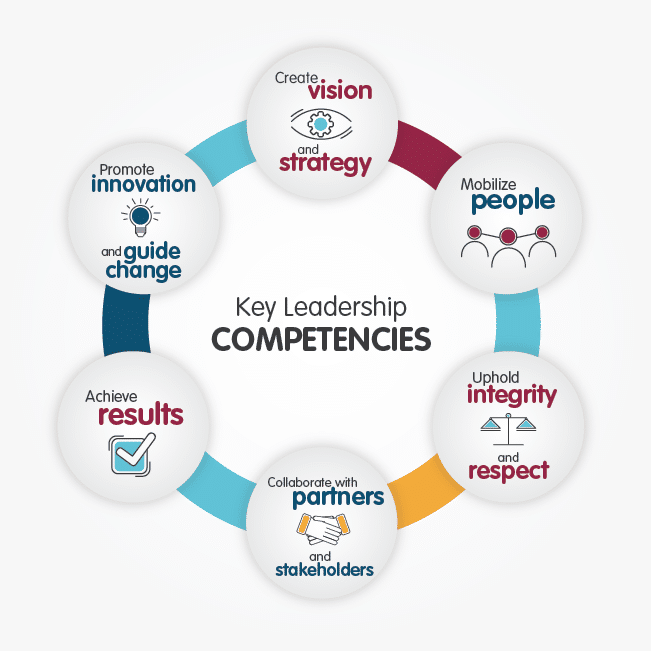
Apart from the organization specific competencies, top 6 leadership competencies, that every prospective leader needs to have are:

  1. Vision & Strategy – The ability to strategize and aim for a larger vision for the organization is the fundamental sign of a leader. This includes agile business acumen, without which vision of futuristic path is not possible. Does the employee look beyond his specified job responsibilities to better understand the larger business processes of which his work is a part? While getting the job done, is the professional also able to view possibilities of creative solutions and the larger role that the organization can play in the process.
  2. Mobilize Team -The ability to drive the team in any environment and optimize the work of the team rather than individual job performance. Inspiring the team by walking the talk and also establishing deeper connections with the team members, reduces unnecessary attrition. This also helps the leader coach -mentor and prepare his next line of leaders. The biggest attribute of being a leader is the capability of creating more leaders in the system rather than followers. Effective delegation -accountability -coaching for the team performance is imperative.
  3. Upholding Integrity and respect -At times of crisis or even success, the employee needs to operate with integrity and respect towards stakeholders. The leader is always under informal surveillance by the team -clients -senior leadership, thus upholding all values of the system is of utmost importance. As the captain of the ship, the leaders need to be on self vigil to avoid any gaps concerning integrity and respect. Integrity is being real, honest, and trustworthy. Does the employee take responsibility for errors or tend to blame others when something goes wrong? 
  4. Collaboration -The ability to collaborate with Peers -Partners -Stakeholders without biases is another important competence that a leader needs to constantly nurture. Collaborative communication facilitates smooth implementations and also desired outcomes. Working in ambiguity with a cross-functional team with contradictory priorities or opinions is a natural ability that every leader needs to have in this dynamic world of frequent changes and contingencies.
  5. Achieve Results -Commitment to delivering results no matter what the challenges and issues in the changing market. Strong need and ability to deliver at all times irrespective of circumstances is a consistent mindset. The ability to see the larger picture, beyond job responsibilities, and work toward improving business processes and results.
  6. Promote Innovation & Change -Ability of an individual to go above and beyond the demands of his role and responsibilities for the good of the organization. Demonstrating a mission of bringing in the best of industry practices and also promoting innovative methods of solving issues for automation -profitability is a trait of every successful successor. Supporting under-performers through setting an example, coaching, and encouraging a CAN DO attitude towards change for the better.

To score your pipeline of leaders, apart from assessing them on the above competencies, you could also organize developmental programs to hone their skills. While many e-learning options are already available, a workshop mode in a capsule methodology works well for the best outcomes. For support you could click on the link below –Diagnostic Chemistry Session.

Do you think competency mapping is an important exercise? Do you need to revisit your competencies based on the change in the ecosystem and client priorities? What is your take on leadership development investments? Have you signed off the competency framework and succession planning exercise for your exercise? Do share your thoughts on the same with us. Looking for support on Competency Mapping -behavioral labs or success planning -leadership development, click on the link below:

Talent Mapping Exercise

Click here to explore more on Competency mapping science.

SETTING WISE BOUNDARIES| FINDING YOUR VOICE|

Lao Tzu “Care about what other people think and... - Truth of Words -  Sincere Quotes. Videos & Pictures
YOU CAN SET YOUR OWN BOUNDARIES

In an age of TRPs and stars, it is difficult to practice freedom of expression, without being judged. Recently, when I met some friends and industry colleagues, we resonated on the same thought, life is more than following the cheese!! It is more about finding your voice and expressing the same with your tribe. The voice also needs a holy grail to become more resolute. Thus setting wise boundaries for whatever we desire in life, without being caught in the web of fear and judgment is advisable.

From the onset of civilization we are social creatures, craving for connections, thriving on herd mentality and seeking solace with each other. Our survival has been dependent on this power of togetherness. Since ancient times you are either accepted or ousted by the tribe. This hard-wired brain continues to adhere to the tribe guidelines, while we continue to struggle with our inner voice.

Our brain mostly says, “Let’s do whatever keeps the tribe happy. Let’s do whatever we need to, to be part of the gang.” Most of the time that looks like reluctant acceptance, going along to get along, and doing whatever we can to “not rock the boat. Finding a balance between People Pleasing, listening to an inner voice, and setting reasonable boundaries has become a need to live your full potential.

We are groomed from our childhood to understand the rules and norms of the herd and to follow the same. However, we are barely taught how we need to hone the inner voice and strategize the wise boundaries, to enjoy every facet of life. In our professional and personal life creating these healthy boundaries can go a long way to protect our values- beliefs and outcomes. Sometimes the surrounding thinking -perceptions -comments or even judgments cloud our voice-mind -brain so much that it can negatively influence our wellbeing.

In fact, research on Herd Mentality reveals, a behavior that is consistent among many species — that is, making decisions based upon the actions of others. Researchers discovered that it takes a minority five percent to influence a crowd’s direction — and that the other 95 percent follow without realizing it.

Caregivers, teachers, coaches, and parents are the first tribe seniors who influence this making of the herd mindset. It is time we start supporting the power of the inner voice, and facilitate a balance that is first attribute for excellence.

6 Simple ways to balance between the herd norms, and inner voice :

  1. Awareness of One’s Values & Beliefs: Value systems vary from person to person, thus comparing notes may not be helpful at all times. These personal values and beliefs also need to be revisited from time to time …as with time and experience, our outlook towards life also changes. To create a happy & harmonious space, it’s helpful to revisit what is below the iceberg.
  2. Refrain from Comparisons -Our otherwise fulfilling life can start looking at a lost profit and loss account when we keep comparing with others, without counting our blessings which cannot be quantified.
  3. Step out of Guilt -Looking at the past with a sense of guilt for what has been missed is common self-sabotage. Thus the best way to redeem past mistakes is to start a new chapter on our terms.
  4. Questioning Your choices – We often make choices blindly and then brood over the same. It’s time to watch your boundaries and reasons while making choices that don’t align with your values-beliefs and principles.
  5. Create Wise Boundaries -Boundaries are inner preferences thus we need no endorsement to design them. Boundary work starts by addressing our issues. And as the inner work is done and healing occurs, it organically flows into changed outer behaviors, habits, and choices. We can be empowered to have loving and compassionate conversations that build bridges of connection rather than walls of isolation. This also helps others understand us better.
  6. Knowing your needs – Do you know your needs? Occasionally we think of what we truly want in our lives. For example, if you are a parent who wants to give the best to the child …Start by thinking of what a “good” parent would do for their child. What needs do they help their child remember to meet? etc. For each need, you could ask yourself 5 why questions or kanbanize

How do you say ‘no’? How important is it to please others? How do you want to build a balance with boundaries-coexisting with others? Are your decisions based on your herd choices? Do share with us your perspectives.

ARE YOU IN LOVE WITH YOUR CRAFT| CELEBRATING VALENTINES|

If You Want to Enjoy Work, Try to Be More Playful | The Muse
CELEBRATING LOVE FOR YOUR CRAFT

Today is Valentine’s Day and while we celebrate our loved ones, who are our life breath; let’s also celebrate our craft which gives us unconditional love, inner meaning, and support in our life journey every day.

The biggest bliss we experience in our life is with our craft! More than 70% of our life is spent on our work-craft -job-art-sports or things we do for a LIVING -LOVING-LEARNING-LAUGHING…Flow state is an outcome of being in love, and not sweat and toil!! If you look at the top 3 percent in any successful professions, they are in a zone of excellence because of love for what they do. The best and happiest artists -dancer-programmer -teacher -singer -author- chef -sports person -actor, leader, …are not lucky they are just in obsessive love with what they do. They re-invent their ways to create by spending long hours with their craft. Sometimes it yields the best of returns and sometimes it doesn’t, yet it’s never a loss being in this relationship as it takes us to new peaks of our life experience. Your work never lets you down when your commitment is strong. This relationship does go through highs and lows, however, you can always define your sweet spot with your love!! There is always a way to celebrate your craft if you are willing to revisit your methodology.

Finding our vocational valentine necessitates strong inner introspection and is a strong reason for what the divine has carved us out for. Sometimes it’s intuitive and sometimes it needs many experiments before we find our true love!! Once we find it, it is sheer joy, as it is effortless to get into a zone, feeling of being on a pedestal, blissful experience, and feel the high. However, like any other relationship, this also can start feeling mundane, monotonous, or taken for granted …unless you believe in the LOVE and the joy of celebrating the same consciously!!!

Can you remember your first few months in your new role, it was full of learning, meeting new people, and achieving great things (not far from the first few months of a new relationship!!). Then one day it begins to get boring, every day seems the same and you’ve lost all motivation for the work-job-craft!! However, if you have the desire to rekindle this love for your craft -work-job, you can take a step forward.

6 Ways to celebrate your work as your Valentine :

  1. Flashback -Once you look back at yesteryears of all the accomplishments, recognitions, and milestones that you have experienced in your work…your valentine seems very worthy of all the accolades. It could be your client call, team success, program design, great appraisal conversations, great sales pitch, … all can seduce you back into the obsessive love you feel for your work!! Going back to basics is sometimes the best solution!
  2. Try a New GPS – Every work needs creativity and innovation in the way you exhibit the best possibilities. So trying new methods in your craft is something that keeps it innovative and exciting.
  3. Express Yourself – Often we expect our loved ones to have an intuitive understanding of us…which may not fructify into ideal results. Likewise, if something is bothering you about your work it’s time to express and discuss. It could be an expectation from colleagues or even yourself. Time to settle scores by communicating. Magical changes happen when we take the initiative to work things out. Being open to conversations -interactions -suggestions can also be a part of this expression.
  4. Inner Meditative Dialogue -Sometimes going within also reveals the best we can do with our craft. In today’s world, we overemphasize external locus of control -external feedback, society, etc more than our inner needs. Thus an inner dialogue can help you understand what’s next to be explored in your domain or craft.
  5. Reworking the lows – Every love relationship has some highs and lows. Thus working on the lows is also a part of keeping the relationship alive and exciting. Making changes to feel the best in your relationship with your craft is something that can reveal new dimensions you are yet to explore. Could it be as simple as changing your surroundings? It’s easy for things to become mundane after some time so change it up! Sit at a new desk, ask a different colleague out to lunch, or create a new workday plan.
  6. Growth with Gratitude -Gratitude for our skills -talents -powers in our craft is something that we can practice every day. This also helps us grow our current capabilities and nurture prospects.

It is Valentine’s day, remember you wouldn’t stay in a relationship if you weren’t happy…And our Work should be the same! Being in love with our WORK can be one of the best therapies of life!!  

INDIA’S PRIDE -INNOVATORS| VINISHA UMASHANKAR|

14-yr-old Vinisha Umashankar's BRILLIANT idea to fight air pollution -  Rediff.com Get Ahead
YOUTH OF INDIA -SAVIOURS OF EARTH

The youth of India is on the path of being saviors of earth. While we face a huge climate crisis across the world, and drowning in consumerism, the next generation has taken it as their purpose of life. In Success Studio’s Youth Series Bhaskar Natarajan -Passionate Millennial coach scouts for youth in oblivion doing path-breaking work. Bhaskar’s new find is in the world news getting awards for her innovation –Vinisha Umashankar.

It’s really a pride for India to have youngsters from humble backgrounds, solving problems for the earth and creating a new career path as innovators-change makers, and passionate new age professionals who are starting young, to usher in a new era of doing purposeful life-changing work…

”Young people have every reason to be angry with leaders who have failed to deliver”, Ms. Umashankar said. ( The Hindu ) A class 10 student Vinisha is from Tiruvannamalai in northern Tamil Nadu. She has been awarded the climate award for 2021 by Sweden-based Children’s Climate Foundation ( significant climate-related awards for young innovators) She has also received many national and international recognitions for her work. The recent one being one of the finalists for the Earth shot Prize. She was asked by Prince William, Duke of Cambridge, to speak her mind on clean energy at a meeting that discussed clean technology and innovation as part of the 26th U.N. Climate Change Conference of Parties (COP26) in Glasgow, the U.K. Among her audience were world leaders, including British Prime Minister Boris Johnson, U.S. President Joe Biden, and Prime Minister Narendra Modi.

YOU TO THE POWER TECHNOLOGY & HUMANITY

In this interview with Bhaskar, Vinisha shares her story of how she has worked on her innovation. Her parents also talk about the way they nurtured her aptitude to facilitate her success journey. Inspired by the Nobel Laureates C. V. Raman and Marie Curie, she is focused on working on innovations that can reduce carbon footprint. Her innovation in the ‘Çlean Air”category has won recognition in Earth shot Awards 2021. She has transcended limitations and stereotypes of age -gender -geography to work on her goals. Her vision is to support society -environment and business scalability.

The interview also touches upon the parenting style that nurtures such streaks of excellence and brilliance. More than commanding parents today we need to learn and collaborate with the new age children who come with innovative ideas and difficult questions that can change the world for better. Mr. Umashankar also shares an interesting aspect of learning together, things that we may have totally ignored in our environment.

It is time we woke up to the needs and vision of the next generation and supported their mission for a more sustainable -eco-friendly lifestyle. A good start can be measuring your contribution to carbon footprint today and making some simple changes to support in preserving the earth.

To know more watch Vinisha’s entire interview in the link below

‘YOUTH SERIES WITH BHASKAR NATARAJAN & VINISHA UMASHANKAR’

Do share with us your thoughts on Vinisha’s innovation.

6 WAYS TO ENHANCE PERFORMANCE| APPRAISAL MANAGEMENT|

ENHANCE PERFORMANCE TO CLAIM YOUR POTENTIAL

Success at work is largely driven by Performance Appraisal and Goal Accomplishment. 70% of our life revolves around our work goals and how we navigate the success of the same, yet sometimes in spite of all the focus and hard work, things don’t work.

Organizations have various tools to evaluate the performance of a leader like self-appraisal, team feedback, skip meetings, 360 degrees, etc. Studies show a strong correlation between performance management -productivity and organizational success. Performance management can be a brilliant way to inspire -motivate and coach an employee towards the best practices and also give their best to their job role. However often this path creates ambiguity and stress. While organizations continue to explore ways to make this an effective tool, employees can master this tool to gain pace in their careers.

6 Ways to enhance performance and manage appraisals proactively:

  1. Clarity of Expectations – Performance as leaders or even as subject matter experts starts with clarity of goals. We all want to be winners yet the GPS to the destination is not clear to us. Working with the organization and the supervisor to get clarity while creating this GPS is essential even before one starts the journey towards the goals. What would successful performance look like, is a vision that one needs to design for one’s hours of toil to be worthy? This also helps in building a conducive supervisor-subordinate relationship. The best way to work with the dynamics of team -leadership is to create clarity for self and others, and also empathize with people -situations to build the best outcomes rather than expect others to create it.
  2. Managing Priorities & Speed -To improve performance at work you must have the ability to set priorities and to separate the relevant from the irrelevant when facing the many tasks of the day. Every leader values a person who can set priorities and move quickly to get the job done. Speed and dependability in job completion is one of the most valued traits in the workforce. When your employer can hand you a job and then walk away and not worry about it again, you will have moved onto the fast track. Your subsequent promotion and increased pay are virtually guaranteed.
  3. Positive Mental Attitude -With everyday stresses, escalations and challenges…often skepticism creeps in, amidst all this it’s imperative for a professional to be in a positive mind state while taking decisions and interacting with clients or teams. A captain of the ship always needs to bounce back from any exigency that he might have faced, else he might lose opportunities when the weather is conducive for his progress. People like to be around and to promote employees they like. Everybody quickly notices a consistent, persistent attitude of cheerfulness and optimism. When you make an effort to cultivate an attitude of friendliness toward people, they will make extraordinary efforts to open doors for you.
  4. Improve Your Skills, Seek Knowledge -Improve performance at work by continually upgrading your work-related skills and making sure that your superiors know about it. Today the best courses are available online, that can be leveraged for best outcomes in your job success. Sometimes the organizations pay for the courses you take so seek support where they can sponsor. Make optimal use of your mentors -coaches -supervisors and peers to unveil the best learnings and knowledge that can augment your performance. Efforts of learning and networking create an aura of leadership growth in your career. Bosses are very impressed with people who are constantly striving to learn more in order to increase their value to their companies. Upgrading your knowledge and skills as a part of your life can really accelerate your career.
  5. Personality At Work -Probably 85 percent of your success in the world of work will come from your personality and your ability to communicate effectively with others. It will be determined by how much people like you and respect you. You can greatly improve how other people perceive you by continually looking for ways to boost their self-esteem throughout the workday. A little genuine praise and appreciation, on a regular basis, will cause people to like you and want to help you. A likeable person is often perceived as being better at what they do than a person with a negative personality. When you are with your superiors, make it a practice to listen with respect, attentiveness, and interest. All leaders are excellent listeners. It is a key method of influence. If you want to get people on your side, practice asking interesting questions and then listening intently to the answers.
  6. Keep Network Fuelled & Take Action -Your net worth can be built on the edifice of your fuelled network -a function of your skills – foresight. While you build your network you also need to take action in supporting them and being there for them, rather than keep things dormant. Every person has knowledge -skill, and ideas that could be a part of your repertoire if you can leverage the same. Thus taking action on staying in touch with your inner and outer circle, imbibing best skills, being futuristic, and creating an opportunity rather than waiting for it.

Performance motivation can create more fulfilment and satisfaction in life. Thus designing a path for performance success can help you experience the best that life has to offer. Today successful organizations need an intrapreneur, rather than just a follower to execute orders, to stay ahead of competition and also be an industry leader.

Are you happy with your Performance? What steps can you take to create your growth? Are you building the skills for the right GPS? Do you have clarity on what Best Performance is in your role? Is your chemistry with your supervisor or client stopping you from giving your best? Do share with us your success factors to performance mastery.

NURTURING HIGH POTENTIAL TALENT| TALENT WAR|

Talent Management HR Human Resources Management Team Building Concept on  Virtual Screen. Stock Image - Image of white, hiring: 204148745
HIG POTENTIAL TALENT PLANNING

In the knowledge and the digital economy, talent deficit is the biggest crisis that organizations are facing in scaling talent pool and delivering the promise. In a world where things are rapidly changing, the ability to hire and retain minds who can learn at this meteoric speed is important for business success. Discussions of talent management frequently overlook the perspectives of nurturing high-potential talent. In fact, while needs of the high potential should be prioritized, exploration of diverse workforce can support seamless delivery and client delight.

”The term “high-potential” means that an employee possesses superior or rare qualities and skills that give him a possibility of development to help the company achieve corporate objectives and be successful in the future. Therefore, the high-potential employee can develop his capacities and will be able to learn and gain experience during his career”(Lombardo& Eichinger, 2000).

Organizations today are also building academies, centre of excellence, partnering with universities to facilitate more opportunities to face the talent crunch rather than getting into a talent war. Nurturing the right talent is more than just hiring and training the best, it is a system and culture that invests in continuous honing the new-age skills and sharpening the saw. High potential employees are difficult to retain if they are not engaged in challenging projects, as they have an innate need to learn while they perform. Thus creating levels of difficulty for them to face is also something that the leaders need to strategize. Today’s gen Z’s motivation is beyond money, they need a worthy cause and purpose that fuels them to rise and recognize their inner powers.

Research and forecast say that future talent would operate independently as smaller cohorts. More than corporate designation and entrepreneurial bondage, what appeals to the new era of talent is the independence of creativity and immersive experience of life. New age futuristic organizations have made space and design to accommodate such talents.

Creating Talent Pool

Organizations are investing in various methodologies to create a Talent pool that can address their growth challenges. Efforts are being channelized to attract, develop, and retain skilled and valuable employees. Nurturing Talent and Organizational success have become two sides of the same coin. The leadership pipeline is designed to help the organization source, reward, evaluate, develop, and move employees into various roles. The pipeline bends, turns, and sometimes breaks as organizations identify who is “ready now” and who is “on track” for upcoming roles in future.

With the advent of Tech, the workspace of 2030 may look different with robots working alongside and engaging with us! Our ability to adapt to change and redesign our abilities would be the biggest skill required in times to come. Effective change leadership requires leaders to work with HR to invest in algorithms that identify skills and competencies, and modify employee profile tools to display portfolios of work rather than job titles. In this new era, constant skilling, upskilling and digital dexterity will outweigh tenure and experience.

6 Ways to Create High Potential talent:

  1. Strong Competency Matrix -High potentials are more committed and engaged when they have clarity. Thus organizational charter of roles and competency alignment is a mandatory tool for aligning and nurturing talent. This also supports career pathing and potential diversity in work and creating a challenging career path. High potentials want to understand the next steps in terms of development, experience, and movement. Engaging talent is sometimes the biggest roadblock that needs to be demystified to create -retain-engage and grow them.
  2. Diverse Hybrid Flexible Workspace -High potential talent also needs larger flexibility while they operate. It is common in digital business, built on vast networks and ecosystems, to work across communities of people and businesses globally. In a flat world with avatar and tech support, language -geography barriers are blurred and so has leveraging global talent. This has enabled talent to work with each other across boundaries.
  3. Greater Authority -By giving greater authority in projects, high potential individuals can be empowered to take up larger responsibilities. Special assignments are described as high-profile work, participation on a task force team, as well as role rotations, can also create an environment of nurturing talent. While it may seem that organizations just reward their high-potential talent with more work, the assignments are often viewed by the recipients as opportunities, not burdens. As high potentials receive greater responsibility, they are also looking for greater authority to make decisions that have a significant impact on the organization. High potentials are often given more visibility and access to senior managers than other employees.
  4. More Air Time for Feedforward – To create -retain -grow high potential talent organizations also need more communication -coaching -mentoring, feedforward sessions, and workshops. It is more like coaching an Olympian for the final performance. Thus regular interaction is important for building organizational top talent.
  5. Transparency in selection – The degree of transparency and formality in your process of identifying high potentials impacts how employees see themselves and the organization. Organizations should understand the implications of their approach and weigh the tradeoffs.
  6. Mutually beneficial relationship-A mutually beneficial relationship between organization and talent means addressing the benefits individuals receive as employees and explicitly stating the benefits the organization receives from its employees. High potentials receive the investment in development they want from their organization, and organizations receive not only a more committed and engaged group of leaders but also stronger performance and bottom-line results. High potentials can also be leveraged to develop and coach other upcoming talents within the organization.

How are you creating your talent pool as an organization? Whats your leadership strategy to attract best talent? Do you think you want to explore the new age hybrid of machine (robots) and man as your workforce? How do you want to redesign your workforce to stay relevant?

To reinvent your talent pool explore the following resources –

  1. Man & Machine as workforce
  2. Sustainable Workplace
  3. 2030 Workplace Scenarios

HEALTHCARE DECODED|HOLISTIC CARE|

HOLISTIC HEALTH CARE THROUGH AYURVEDA-DENTAL -MEDICAL -EMOTIONAL HEALTH PRACTICE

The journey to any success starts with peak health on all fronts of BODY-MIND-SOUL. A systematic preventive healthcare mechanism can help you avoid major ailments and also deal with the inevitable ones. The pandemic has heightened our awareness that co-morbidities can be fatal while dealing with various viral or bacterial issues.

Health can be measured in many ways and is often broken down into a variety of numbers and diagnoses that don’t often provide the best picture of what a truly healthy body and mind look like.

While modern-day western medicine has brought many wonderful and life-saving advancements, one of the downfalls of western medicine is the often siloed approach to health, which looks at the body in sections of individual symptoms and pieces rather than the whole system it is. Holistic health can truly achieve optimal wellness in the physical, mental, and spiritual sense, and supports our incredible body mechanism.

HOLISTIC HEALTH-A DEFINITION

Holistic health or holistic healing is often defined as a form of healing that looks at the whole person: body, mind, and spirit. Holistic healing often involves multiple complementary medicines and alternative healthcare practices that can overlap modern scientific interventions.

Some of the Holistic interventions in the realm of health management are:

  1. Mindfulness -mindset – affirmation and visualisation
  2. Yoga -Ayurveda -Nutrition
  3. Chiropractic
  4. herbalism
  5. massage
  6. energy work (reiki)
  7. therapy
  8. acupuncture
  9. physical therapy
  10. general western medicine
  11. personal training

When all of these complementary therapies come together for holistic healing, a person is much more likely to experience wellness on a deeper level. While life expectancy has gone up to an average of 85-100, experiencing chronically high levels of stress and fatigue, consuming nutrient-depleted foods, and exposure to hundreds of potentially harmful chemicals in the air, water, has also become a part of our life.

For many living with chronic disease and undiagnosable symptoms, the modern-day healthcare industry has failed them, thus it’s imperative that a more holistic, whole-body solution becomes a standard practice to treat and support the health of the billions of people living on this planet.

This Panel discussion with experts from Ayurveda (Dr. Vasudha) -Western Science (Dr. Ajay) -Dental (Dr. Swati) -Mental -Spiritual healing (Dr.Sonali) have discussed 4 domains of holistic healthcare systems, that can help you work towards a healthy and happy life.

Key areas covered in the panel discussion are :

  1. Western Medical Science – Healthcare today has advanced by leaps and bounds to give cures for many deadly diseases. The COVID vaccine and its variation have been a saviour to millions in the hour of fear and confusion while diagnosing its fatalities and impacting large numbers. The Healthcare industry is facing a crisis to save their practitioners on one hand and dealing with ambiguity on the other.
  2. Dental Science and Impact on health –Holistic dentistry is an alternative to traditional dental care. In recent years, this type of dentistry has grown in popularity. Many people are attracted to its holistic approach and more natural remedies. Healthcare starts with teeth and mouth hygiene that determines how your body functions. The tenants of holistic dentistry are right nutrition, avoidance of toxins in dental materials, prevention of gum disease, regular care regime, etc.
  3. Mind & Spiritual life approach -Research today accepts the mind as the biggest initiator or healer of the disease. By your mind and soul connect you can direct your life towards a healthy living practice. Dr. David R Hawkin‘s research (renowned psychiatrist, physician, researcher, spiritual teacher, and lecturer. )has made a unique contribution to humanity, by sharing the different levels in enlightenment. His book Power Vs Force is a testimony of how our mind can control our life quality. As per WHO -“Mental health conditions are increasing worldwide. Mainly because of demographic changes, there has been a 13% rise in mental health conditions and substance use disorders …one in five people in post-conflict settings have a mental health condition.”
  4. Ayurveda and Yogic Science – The medical world today recognises Ayurveda as a science that heals. John Hopkins Medicine recognises Ayurveda treatment starts with an internal purification process, followed by a special diet, herbal remedies, massage therapy, yoga, and meditation. Ayurveda has been India’s ancient science and practice to cure. ”The knowledge of Ayurveda was passed on orally through a lineage of sages in India until it was collated into text more than five thousand years ago. The oldest known texts on Ayurveda are the Charaka Samhita, Sushruta Samhita, and the Ashtanga Hrudaya. These texts detail the affect that the five elements found in the cosmic system – earth, water, air, fire, space – have on our system, and expound on the importance of keeping these elements balanced for a healthy and happy life.” (ART OF LIVING)

To know more about what practices and behaviors can help facilitate a healthy -happy -harmonious life, do see the entire panel discussionDECODE HEALTHCARE. We look forward to hear more from you on how you have been dealing with challenges during the pandemic and making a come back into normalcy.

IMPACT THROUGH INFLUENCE| INFLUENCE TO BRING CHANGE|

What is influence and what are influencing skills? - Roffey Park Institute
INFLUENCE TO IMPACT

Leadership and management are primarily driven by your influencing abilities. Every department has an innate need for influencing skills starting with Sales -Marketing -Strategy to Human Resources, Learning, Finance, and other functions. We are negotiators, persuaders, conciliators, and maybe intermediaries and mediators at various times in our life journey. Organizations today realize this as one of the key competencies to thrive-survive and revive.

As organizational hierarchies and layers diminish, developing personal effectiveness and influencing skills is essential in today’s workplace. Being able to influence without formal authority is an essential skill, and this can be achieved through confidence, clarity, and communication skills. And as leaders, our roles require that we draw on who we are, as well as what we do to inspire and engage our people. This new IQ=Influencing Quotient can be one of the most effective skills to have in your leadership repertoire.

Personal influence at work and its impact on your relationships, career, and organizational success have a far-reaching impact that we all aspire for. Talent development and Human capital professionals have a tremendous opportunity to influence at a deeper level—with learners, SMEs, and stakeholders—to achieve business and learning results.

The influence could be for dealing with dynamics, self-expression & branding, building trust, and networking. However one needs to be clear on the larger goal of influence and not manipulate. The context in every act of influence is critical for the outcomes.

Effective, ethical leaders use different approaches in different situations, choosing carefully when and how to influence people using influencing tactics that appeal to the head, heart, or hands. While creating buy-in for project approval, hiring, or client value creation one needs to have a unanimous approach towards certain executions, where influence plays a crucial role.

Some of the common questions to think of while influencing are –

  1. Who to influence?
  2. What is the outcome desired?
  3. How can the idea or decision gain through the participation of others?
  4. What tactics can be used?
  5. Why would someone be interested in the proposition? 
  6. How to keep it optimistic while closing irrespective of decision?

6 Ways to culture influencing skills –

  1. Communication Pointers (Observation & Interpretation, Analysis, Feedback, Rapport building) -Paying attention to body language, non-verbal behavior – what is not said, your thoughts, feelings, hunches, and intuitions. Also analyzing and interpreting body signs, changes in skin color, breathing, demeanor, etc. Communication is more than words and what’s being said. Communication is the medium and also the way to progress towards influencing goals. You can ask, request, create a rationale for the need or idea while working on your journey of influence.
  2. Awareness & Choices – Be aware of yourself, moment by moment, particularly of counter-productive behaviors, your limiting thoughts, beliefs, and reactions; recognize at any moment that, if how you are behaving is unproductive, you can change your thoughts, feelings, and behaviors.
  3. Self-confidence – to feel confident about yourself in the face of resistance or conflict. This confidence should be based on acceptance of self and not on feeling superiority to the other person.
  4. Timing – Be able to get the timing right such as when to give feedback and when not to, when to use choice ‘A’ or ‘B’, when to retreat or be persistent and when to let go completely.
  5. Intuition – Trust your feelings or hunches about the likely patterns of the other person’s behavior, to listen to your positive, inner voice.
  6. Work on a win-win – To Balance, a win-win for all stakeholders can be an effective mode to work on the subject to be influenced. You cannot control or order them to agree, so decide what’s in it for them, sell them the benefits, consider their feelings and be adaptable to change.

One of the best things I learned from the BNI(Business Networking International) forum is VCP -Visibility -Credibility and Profitability. Dr. Ivan Misner and his team across the world have coined this wonderful concept that supports not only business owners but also professionals to build and nurture their brands, by way of subtle influence. Your visible work that builds credibility eventually creates profitability for you. Thus being visible first in an ocean of talents, executing work credibly are two pillars for long-term profitability and infuence.

Today’s working environment depends on relationships and influencing skills – both working with and through other people. Influence in current times is reciprocal giving and taking from others that creates opportunities for your growth and effectiveness.

How well do you influence your stakeholders? What are the practices that help you influence better? Are you willing to flex in the journey of influence? Do share with us your inputs for Influencing skills development. To master these skills register for a workshop on Influencing Skills.