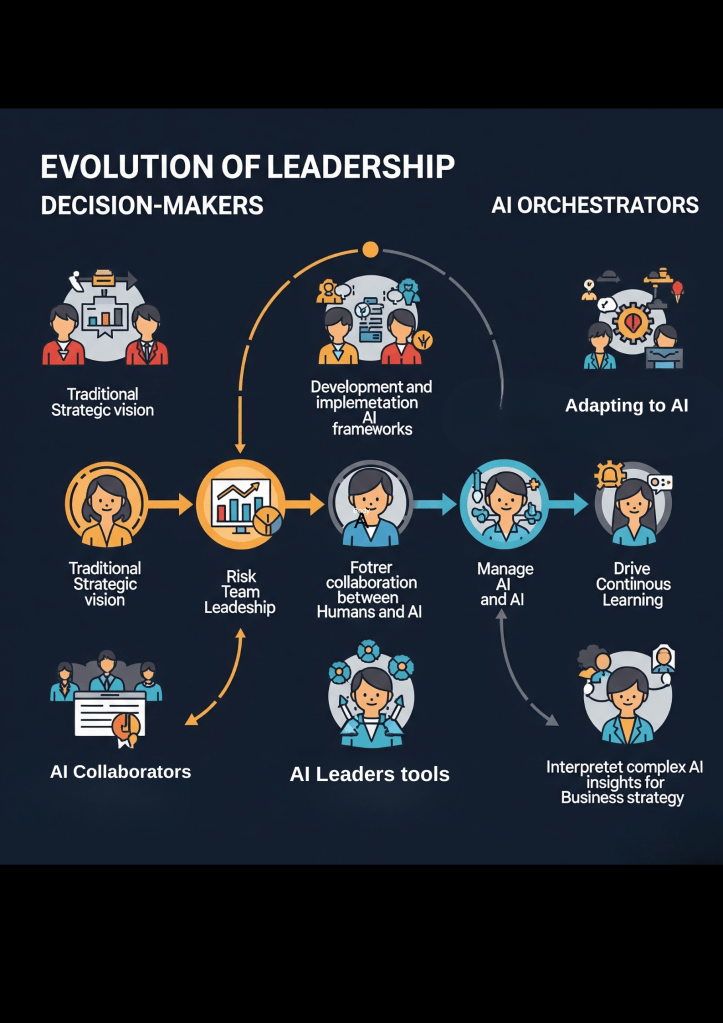
In an era defined by rapid technological advancement, the role of leadership is undergoing a profound transformation. We are moving beyond a time where leaders primarily made decisions, towards a future where their crucial function will be to orchestrate artificial intelligence. This shift from “Decision-Makers” to “AI Orchestrators” isn’t merely a change in title; it signifies a fundamental redefinition of leadership skills, strategies, and even organizational structures.
Historically, the archetypal leader was someone who possessed deep industry knowledge, analytical prowess, and the courage to make tough calls. Their authority stemmed from their ability to synthesize information, identify optimal paths, and direct human resources accordingly. This model, while effective for decades, is increasingly being challenged by the exponential growth of data and the sophisticated analytical capabilities of AI. AI can now process and analyze vast datasets, identify patterns, and even propose solutions with a speed and accuracy that far surpasses human capacity.
The rise of AI doesn’t diminish the need for human leadership; rather, it elevates it to a more strategic and visionary plane. The AI orchestrator will be less concerned with individual decisions and more focused on designing the intelligent systems that make those decisions. This involves a complex interplay of responsibilities:
Firstly, strategic vision and ethical AI development become paramount. Leaders must define the organizational goals that AI will serve, ensuring alignment with company values and societal well-being. This includes grappling with ethical considerations like algorithmic bias, data privacy, and the responsible deployment of automation.
Secondly, cultivating a culture of collaboration and continuous learning is crucial. AI systems thrive on data and feedback. Leaders must foster an environment where human teams and AI collaborate seamlessly, where insights from AI are understood and integrated, and where employees are encouraged to learn and adapt to new AI-powered workflows. This involves investing in upskilling and reskilling initiatives to empower the workforce.
Thirdly, designing and managing the AI ecosystem becomes a core competency. This includes selecting the right AI tools and platforms, integrating them into existing infrastructure, and ensuring data quality and accessibility. It’s about building the architecture that allows AI to function effectively and to scale.
Fourthly, interpreting and acting upon AI-generated insights requires a new level of discernment. While AI can provide sophisticated analyses, it’s the human leader who must understand the nuances, question assumptions, and ultimately translate those insights into actionable strategies that consider human factors, market dynamics, and unforeseen circumstances.
The evolution from decision-maker to AI orchestrator demands a shift in focus from control to enablement, from hierarchy to network, and from individual brilliance to collective intelligence.
Leaders in this new paradigm will be facilitators, designers, and visionaries, guiding their organizations through a landscape increasingly shaped by artificial intelligence. Those who embrace this evolution will not only survive but thrive, leading their organizations to unprecedented levels of innovation and efficiency in the AI-powered future.
 drsonaliduttabaanerjee